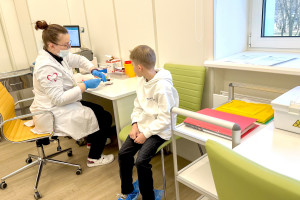
Staś runs fast today and no one would say that he has a serious genetic disease

- This year marks 7 years since the launch of the B.102 drug program in Poland, dedicated to patients with spinal muscular atrophy (SMA). The first drug registered and reimbursed under this program was nusinersen.
- For patients and clinicians, the treatment has been a revolution
- "The youngest child to receive nusinersen in Poland is Staś, who received the drug at 23 hours of age, which was possible thanks to earlier prenatal diagnosis based on family history. Today, Staś runs very fast and no one would think he was sick," emphasized Prof. Anna Kostera-Pruszczyk.

"We are in a unique situation because we have several therapeutic strategies at our disposal and the ability to influence the genetic mechanism of the disease in many ways: from gene therapy involving the administration of a transgene using a viral vector, through antisense oligonucleotides, to small molecules. All of these avenues that were considered in the case of SMA have been successful, and a double success, not only in terms of drug registration, but above all in terms of reimbursement," emphasized Prof. Anna Kostera-Pruszczyk, Chair of the Council for Rare Diseases and Head of the Department and Clinic of Neurology at the University Clinical Center, Medical University of Warsaw.
This revolution began with the reimbursement of the first SMA drug, nusinersen, under the B.102 drug program in 2019. This program covered all patients regardless of SMA type, disease stage, or patient age. This allowed the drug to be administered to pre-symptomatic children as well.
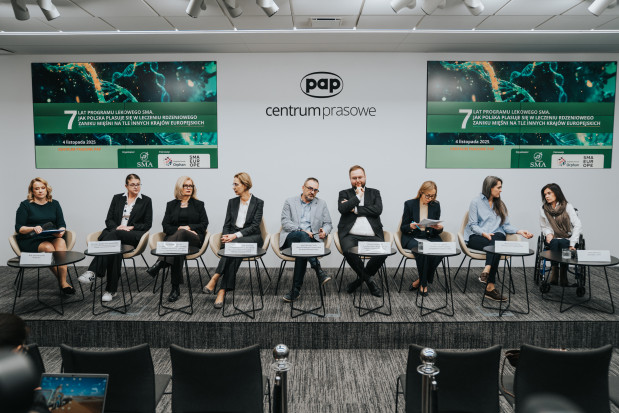
"It's worth remembering that the youngest child to receive nusinersen in Poland was Staś, who received the drug at 23 hours of age, which was possible thanks to earlier prenatal diagnosis based on family history. Today, Staś runs very fast, and no one would think he was ill," the expert emphasized during a conference summarizing seven years of the SMA drug program. How does Poland rank in the treatment of spinal muscular atrophy compared to other European countries?
In 2022, the program was expanded to include gene therapy and an oral drug, and in subsequent years it was modified to cover broader clinical indications, including the possibility of using nusinersen in pregnant women.
In Poland, bridging therapy is also used - nusinersen or risdiplam are given to children with two or three copies of the SMN2 gene until gene therapy can be started.
The program is also flexible enough to be tailored to individual patient circumstances. Marcin Czech, a pharmacoeconomist and former deputy minister of health responsible for drug policy and the decision to launch the B.102 program, summarized data from analyses by the National Health Fund, which shows a systematic increase in the number of patients treated year over year.
"Currently, the SMA treatment program covers over 1,200 patients. We have 203 people who have switched from nusinersen to risdiplam-based therapy. It is possible to return to previous therapy. The program is flexible, tailored to clinical effectiveness and the decisions of clinicians and patients themselves," he noted.
He predicts an increase in the patient population in the coming years: - The number of patients covered by the program could reach 1,500–1,600 people.

The problem in SMA is the rate of motor neuron loss. The loss of each motor neuron translates into loss of function and muscle atrophy.
"In the case of SMA1, the acute form, the degradation process is rapid, and each day and week is critical. In the case of SMA2 and SMA3, although they progress more slowly, these curves inevitably decline. Therefore, the goal of treatment is, firstly, to protect against degeneration and halt this process, and secondly, to maintain motor function," explained Professor Kostera-Pruszczyk.
Thanks to many years of systemic reimbursement, Polish specialists have unique data on the effectiveness of treatment resulting from actual clinical practice.
"We included 887 patients in the long-term follow-up study, who were treated for at least 14 months, and many for much longer. This group includes both children and adults, from newborns to 56 years of age," said Prof. Katarzyna Kotulska-Jóźwiak, Chair of the Coordinating Team for the Treatment of Patients with Spinal Muscular Atrophy and Head of the Neurology and Epileptology Clinic at the Children's Memorial Health Institute (IPCZD), presenting the results of a study summarizing several years of experience with nusinensen in spinal muscular atrophy in Poland.
Treatment outcomes are assessed using two functional scales: CHOP-INTEND (for younger patients or those with more severe disease) and the Hammersmith Functional Motor Scale (HFMSE) for older and less clinically advanced patients. The analysis results demonstrate a significant increase in functional scores during nusinersen therapy. Steady improvement in both scales is observed at each subsequent time point.
"We have a very long history, already eight years, of access to the first therapy that alters the natural course. The drug remains effective in over 99 percent of patients, so over a very long period of time. Importantly, the effectiveness of the treatment does not depend on the patient's age, their neurological condition at the time of initiation of therapy, or the type of disease," emphasized the specialist.
Even longer follow-up results, 30 months, were conducted by teams of neurologists from the Neurology Clinic of the Medical University of Warsaw and the Rydygier Hospital in Krakow, covering a large group of adults treated for SMA.
- The curves showing changes in the CHOP-INTEND score in subsequent months of treatment indicate that even patients in very serious condition and disabled at the time of starting therapy experience clinical benefit, sometimes expressed as stabilization, but often also consisting of very significant improvement - said Prof. Kostera-Pruszczyk.
She emphasized that each subsequent dose of the drug brings further improvement, and the therapeutic effect is maintained and increases even after the first dozen or so months: - In the synthetic approach of the Krakow-Warsaw group, improvement is visible both after 14 and after 30 months, with the 30th month being significantly better than the 14th, and each time point exceeding the initial functional state.
She also cited Hagenacker's meta-analysis, which included data from nearly 1,200 SMA patients, primarily adults but also older adolescents, from 16 countries, across 31 studies, with a follow-up period of approximately four months. The study confirmed that treatment with nusinerser led to maintenance or improvement in motor function.
Treatment is possible thanks to screening. "The screening program is financed by the Ministry of Health. We have individual centers coordinating screening for all newborns, and we currently diagnose over 30 different diseases quite quickly. This makes us one of the best-functioning systems in Europe," emphasized Prof. Monika Gos, head of the Developmental Genetics Laboratory at the Department of Medical Genetics at the Institute of Mother and Child in Warsaw.
In the case of SMA, over 1.1 million newborns have been screened to date, and SMA has been diagnosed in 149 children, implying an incidence of approximately 1 in 7,500 births. The speaker notes that the number of detected cases is decreasing each year, primarily due to the overall decline in birth rates in Poland.
SMA screening is performed using a genetic test, so parental consent is required. Only 0.04% of parents refused to participate in the screening, meaning approximately 400 newborns were not screened over the several years the program was in operation. However, this group may have included children with serious health conditions from whom samples could not be collected.
As it turns out, the treatment options for SMA and the nationwide newborn screening in Poland are unique on a European scale; other countries are only just introducing solutions that have been available in Poland for several years.
"Despite progress, access to the best therapies is still uneven across Europe. In some countries, access to treatment is limited by eligibility criteria such as age, weight, SMA type, or respiratory status. In others, reimbursement is only partial, or treatment is provided through individual patient programs. Many countries are still only in the pilot or planning stages of newborn screening, which makes it difficult to initiate treatment in newborns. This includes countries such as Finland, Greece, the United Kingdom, Romania, and parts of Italy and Spain," admitted Dr. Nicole Gusset, president of SMA Europe, an organization of patient associations from over 28 countries.

We have newborn screening, access to therapy, a high level of care coordination, and an effective model of collaboration between institutions, which brings real results. However, not everything works perfectly. Many supportive services, such as diagnostics, specialist care, and rehabilitation for adult patients, are underestimated. Pricing for procedures often does not reflect their actual workload or the costs incurred by medical facilities.
"We need more SMA treatment centers, and there are still gaps. We don't have pediatric care centers in the Lubusz, Świętokrzyskie, and Opole Voivodeships. In turn, there are no adult centers in the Lublin and Podlaskie Voivodeships," said Prof. Justyna Paprocka, National Consultant for Pediatric Neurology and Head of the Department and Clinic of Pediatric Neurology at the Medical University of Silesia in Katowice.
She added that currently, the largest cost of the drug program is medication, while centers caring for adult patients often struggle with underfunding of other services: - Centers that care for adult patients would be more willing to implement the program if the program's service were more cost-effective.
The problem of the lack of centers in some voivodeships, but also the issue of transitioning SMA patients from pediatric to adult care, is a challenge for the public payer:
"The program is organized in a model manner when it comes to the resources used to treat patients. There is cooperation in transferring patients after the age of 18 to adult centers, but access to neurological centers in some voivodeships is difficult due to a shortage of neurologists. The number of neurologists in Poland is limited, and there are a very large number of conditions currently covered by these specialists," said Iwona Kasprzak, director of the Department of Drug Management at the National Health Fund. "The problem exists particularly in voivodeships in eastern Poland."
The Ministry of Health, in turn, faces a challenge in financing the program given the growing number of patients. The program is not cheap; the cost of SMA treatment has exceeded half a billion złoty, representing a tenfold increase in expenditures over five years.
"Our primary challenge is to be consistent in meeting the burden of patient accumulation. As a result of our actions, patients are living longer, their health is accumulating, and individual expenditures on the drug program are also increasing. Therefore, we need to adopt financial solutions and be mindful of the program's long-term financing," said Mateusz Oczkowski, Deputy Director of the Department of Drug Policy and Pharmacy at the Ministry of Health.
He indicated that it will be some time before generic competition appears and new therapeutic options appear on the horizon.

Indeed, many new therapeutic options are on the horizon. These developments include both new therapies in clinical trials and improvements to existing drugs.
"This is a tablet alternative to current oral suspension medications. Studies are also underway on higher-dose intrathecal therapies. We also have new forms of intrathecal medications that allow for much less frequent administration than before. There are also studies involving gene therapy administered intrathecally, not systemically," Prof. Kostera-Pruszczyk mentioned.
She also mentioned research that will make combination therapy possible for at least some patients: administering drugs that increase the production of SMN protein and at the same time enhance muscle function.
Patients are especially eagerly awaiting these new therapeutic options. "We expect to receive registration of a higher dose of nusinersen early next year, as well as the first results of the PIERRE study evaluating the ThecaFlex DRx intrathecal infusion system. This solution will be particularly important for patients who changed their therapy solely due to difficulties administering nusinersen, and there are many such patients," emphasized Katarzyna Pedrycz, vice president of the SMA Foundation.
The success of SMA treatment in Poland translates into a better quality of life for patients who gain greater independence, can be professionally and socially active, continue their education, and enjoy motherhood.
"Thanks to therapy, my life has changed dramatically," admitted Aneta Olkowska, a psychologist, coach, and SMA patient who began treatment in August 2019. She regained her strength, was able to open her own psychological practice, return to work, and travel again. Trips that were previously impossible due to physical limitations have become a symbol of a new phase in her life.
Copyrighted material - reprint rules are specified in the regulations .

rynekzdrowia